


Brief Introduction:
If you have been diagnosed with a problem in the lower portion of your ureter (the tube that carries urine from the kidney to the bladder), such as a narrowing (stenosis) or an injury, robotic ureteral reimplantation may be the most advanced and effective surgical solution for you. This minimally invasive procedure aims to repair the ureter, restoring the normal flow of urine from the kidney to the bladder, with the intent of preserving renal function and relieving your symptoms. In cases where there is a lack of ureteral length, techniques such as the “Psoas Hitch” or the “Boari Flap” can be performed with robotic assistance to ensure a successful reconstruction. This page was created to provide you with clear information about this complex reconstructive surgery.
1. What is the Ureter and What Problems May Require Reimplantation? (A Brief Review)
The Ureter: We have two ureters, one for each kidney. They are thin muscular tubes that actively transport urine from the renal pelvis (the central part of the kidney where urine accumulates) to the bladder.
Common Problems in the Distal (Lower) Ureter that May Require Reimplantation:
Ureteral Stenosis (Narrowing): This is the most common cause. It consists of an abnormal narrowing of a segment of the ureter, usually due to the formation of scar tissue (fibrosis). This narrowing hinders or blocks the passage of urine, potentially causing pain, infections, and kidney damage. Frequent causes include:
- Post-Surgical (Iatrogenic): Complications from previous surgeries in the pelvis or abdomen (urological, gynecological, colorectal, vascular) where the ureter may have been inadvertently injured or its blood supply compromised.
- Post-Radiotherapy: Radiation therapy for pelvic cancers can cause late fibrosis and narrowing of the ureter.
After Impacted Ureteral Stones: A stone that remains stuck in the ureter for a long period can cause inflammation and scarring. - Endometriosis: In women, endometrial tissue can grow around or infiltrate the ureter wall.
- Chronic Inflammation: Infections such as genitourinary tuberculosis.
Acute Ureteral Injury: Direct damage to the ureter during pelvic or abdominal surgery, or due to external trauma.
Vesicoureteral Reflux (VUR) in Adults (less common, but a possible indication in selected cases): A condition where urine flows backward from the bladder into the ureter and potentially the kidney. In adults, it may be secondary to other conditions or previous treatments. Surgical reimplantation aims to create an effective anti-reflux mechanism.
Distal Ureteral Tumors (rare): In very selected cases of small, low-grade tumors, removing the diseased segment of the ureter and reimplanting it into the bladder may be a therapeutic option.
2. What is Ureteral Reimplantation (Ureteroneocystostomy)?
Definition: Ureteral reimplantation, technically termed ureteroneocystostomy, is a surgical procedure that involves creating a new connection (anastomosis) between the ureter and the bladder.
How it Works (General Principle): The diseased, narrowed, or injured segment of the ureter (usually its distal portion, closest to the bladder) is removed (excised). The remaining healthy end of the ureter is then carefully reimplanted (sutured) into a new opening created in the bladder.
Anti-Reflux Technique: In most cases, especially in adults, reimplantation is performed to create an anti-reflux mechanism. This often involves creating a small submucosal tunnel for the ureter within the bladder wall, which acts as a one-way valve, allowing urine to flow from the ureter to the bladder but preventing it from returning, especially during urination.
Main Objective: To re-establish an unobstructed and, if necessary, unidirectional (preventing reflux) urinary flow from the kidney to the bladder, relieving symptoms, preventing infections, and preserving renal function.
3. Technical Variants for Longer Stenoses or "Short" Ureters
Sometimes, after removing the diseased segment of the ureter, the remaining healthy end may not have enough length to reach the bladder without tension (which is crucial for surgical success). In these situations, the surgeon has more complex reconstructive techniques to “gain length” or “bring the bladder to the ureter”:
Psoas Hitch (Anchoring the Bladder to the Psoas Muscle):
- What it is: In this technique, the bladder is extensively mobilized (freed from its surrounding ligaments and tissues) and moved cranially (toward the patient’s head) in the pelvis. The upper part of the bladder is then fixed (anchored with sutures) to the tendon of the psoas muscle, a large muscle on the posterior abdominal wall. By “lifting” the bladder this way, the distance the ureter must travel to connect to it is shortened, allowing for a tension-free anastomosis.
- When it is used: For distal ureteral stenoses of moderate length (usually up to 6-8 cm of length gap) where gaining a few centimeters is necessary for a safe reimplantation.
Boari Flap (Tubularized Vesical Boari Flap):
- What it is: This technique is used for longer ureteral defects in the distal or mid-distal portion of the ureter. it consists of creating a flap (a long and wide strip) from the anterior wall of the bladder while maintaining its blood supply. This flap is then rolled onto itself to form a tube (similar to a new segment of ureter) that remains attached to the bladder at its base. The upper end of this vesical tube (neo-ureter) is then anastomosed (connected) to the healthy end of the original ureter.
- When it is used: When the distance between the healthy ureter and the bladder is too great to be covered by direct reimplantation or even with a Psoas Hitch alone (usually for length gaps of 10-15 cm). It allows for the replacement of a longer segment of the ureter using the bladder’s own tissue.
4. What is the Robotic Approach (Robot-Assisted Ureteral Reimplantation)?
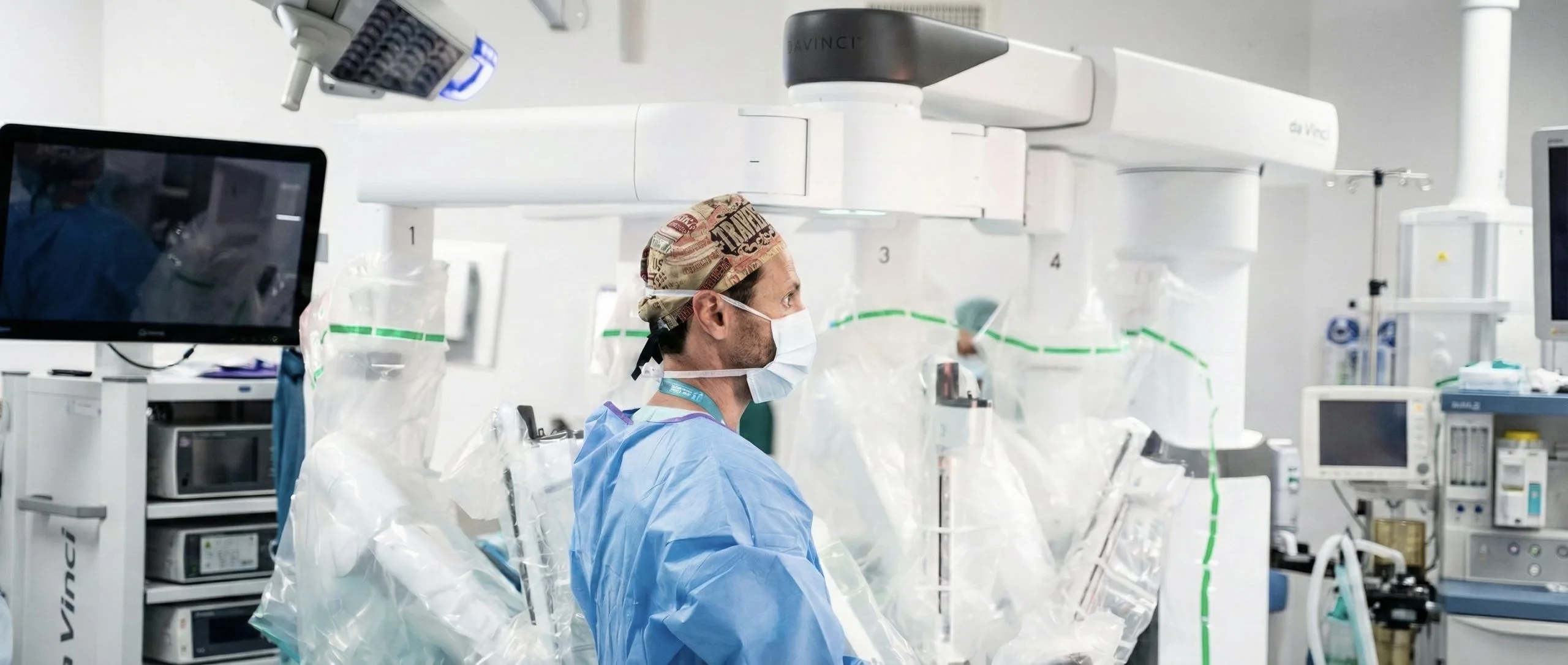
Ureteral reimplantation and its variants (Psoas Hitch, Boari Flap) are delicate reconstructive surgeries. They can be performed via traditional open surgery, conventional laparoscopy, or, with significant advantages, via the robotic route (frequently using the Da Vinci® surgical system).
How Robotic Surgery Works: (Small incisions, 3D camera, articulated instruments controlled by the surgeon at a console).
Differences and Advantages over Other Approaches:
- Open Surgery: Involves a larger lower abdominal incision, resulting in more post-operative pain and a slower recovery.
- Conventional Laparoscopy: Although minimally invasive, it presents significant technical challenges for these reconstructions. Delicate dissection, extensive bladder mobilization, precise Boari Flap creation, and especially the performance of fine, watertight intracorporeal sutures are complex maneuvers with long, rigid laparoscopic instruments and 2D vision.
- Robotic Surgery: The robotic platform is ideally suited for complex reconstructive surgery in the pelvis. Magnified 3D vision, tremor filtration, and articulated instruments (“EndoWrist®”) with 7 degrees of freedom greatly facilitate all steps of ureteral reimplantation, including demanding maneuvers like creating a Boari Flap and performing precise sutures in confined spaces.
5. Advantages of Robotic Ureteral Reimplantation (and its variants)
Robotic technology offers crucial benefits for performing ureteral reimplantation:
Magnified 3D High-Definition Vision: Allows exceptional visualization of pelvic anatomy, including the ureter, bladder, blood vessels, and nerves, facilitating safe and precise dissection.
Greater Precision, Dexterity, and Range of Motion: Articulated robotic instruments are essential for fine tissue manipulation and, fundamentally, for creating precise, delicate, and watertight sutures (anastomoses), even at difficult angles and in deep pelvic spaces.
Ease in Bladder Mobilization and Flap Creation: Robotic technology simplifies and makes maneuvers like the Psoas Hitch or the creation and tubularization of a Boari Flap safer.
Precise Creation of the Anti-Reflux Mechanism: If an anti-reflux technique is planned, robotic precision facilitates the creation of an adequate submucosal tunnel.
Less Blood Loss During Surgery: And less need for blood transfusions.
Less Post-operative Pain.
Shorter Hospital Stay.
Faster Recovery and Earlier Return to Normal Activities.
Better Aesthetic Results: Smaller and more discreet scars.
Excellent Success Rates in Resolving Obstruction and/or Reflux.
6. Who is a Candidate for Robotic Ureteral Reimplantation?
Robotic ureteral reimplantation is an excellent option for most patients (adults and sometimes older children or adolescents) with distal ureter problems requiring surgical correction, such as:
Distal ureteral stenoses (narrowings) from various causes (post-surgical, post-radiotherapy, post-stones, endometriosis, etc.).
Iatrogenic injuries (caused during other surgeries) of the distal ureter.
Certain cases of primary high-grade vesicoureteral reflux in adults, or secondary reflux that does not respond to other treatments.
The choice of specific technique (direct reimplantation, Psoas Hitch, or Boari Flap) will depend on the length and exact location of the stenosis or ureteral defect, as well as bladder mobility.
Candidates must be in adequate physical condition to tolerate general anesthesia and the surgical position. The final decision is always made after a detailed evaluation and discussion with your urologist.
7. Preparation for Surgery
Preparation is similar to other pelvic robotic surgeries and may include:
Pre-anesthesia consultation.
Pre-operative exams.
Medication adjustment.
Fasting.
Possible bowel preparation.
8. The Surgical Procedure (Simplified Description for the Patient)
General anesthesia.
Surgical Positioning: Usually lying on the back (supine position), sometimes with a slight table tilt (Trendelenburg).
Creation of ports and abdominal insufflation.
Robotic docking.
Main Surgical Steps (vary by specific technique):
- Identification and Dissection of the Ureter: The ureter is carefully identified and dissected in the pelvis, preserving its delicate blood supply as much as possible. The diseased or narrowed segment is identified.
- Removal of the Diseased Segment: The narrowed or injured part of the ureter is excised.
- Bladder and Ureter Preparation: Depending on the technique (Direct, Psoas Hitch, or Boari Flap), the ureter is spatulated and the bladder is prepared (mobilized, fixed, or a flap created).
- Uretero-Vesical Anastomosis (New Connection): The healthy end of the ureter is carefully sutured to the bladder (or to the Boari flap). If planned, a submucosal anti-reflux tunnel is created.
- Ureteral Stent Placement (Double J Catheter): Almost invariably, a thin, flexible catheter (Double J stent) is placed internally, extending from the kidney, through the new anastomosis, to the bladder. It serves as an internal mold for healing and ensures drainage.
Finalization: A small abdominal drain and a bladder catheter are usually left in place. Small incisions are closed.
9. Post-operative and Recovery
Hospital Stay: Generally lasts 2 to 5 days, depending on surgery complexity and individual recovery.
Pain Control: Usually well-controlled with analgesics.
Bladder Catheter: Remains in place for several days to 1-2 weeks to allow the bladder and anastomosis to heal.
Double J Stent: Remains in place for several weeks (typically 4 to 8 weeks). During this time, it may cause discomfort or urinary symptoms (frequency, urgency, flank discomfort when urinating, or small amounts of blood in the urine). These symptoms disappear after removal.
Stent Removal: A simple outpatient procedure via cystoscopy with local anesthesia.
Abdominal Drain: If placed, it is usually removed before discharge or in the first days at home.
Recovery at Home: Activity should be increased gradually. Avoid intense efforts or lifting weights for 6 to 8 weeks.
Imaging Follow-up: After surgery and stent removal, imaging tests (ultrasound, renal scintigraphy, or Uro-CT/MRI) will be performed to confirm success.
10. Expected Results and Potential Side Effects/Complications
Expected Results:
- High Success Rates: Generally over 90% in resolving ureteral obstruction or reflux.
- Symptom Relief: Such as flank pain and recurrent urinary infections.
- Preservation or Improvement of Renal Function.
Potential Side Effects and Complications (mostly rare):
- General Surgical Risks: Bleeding, infection, thrombosis, injury to adjacent organs, or port-site hernia.
- Specific Reimplantation Risks:
- Urinary Fistula (Urine Leak): Leakage from the anastomosis or bladder suture. Usually resolves with keeping the catheter/stent longer.
- Recurrent Obstruction or Anastomotic Stenosis: Although rare (<5-10%), the new connection site may narrow again due to excessive scarring.
- Persistent or New Vesicoureteral Reflux.
- Double J Stent Complications: Discomfort, frequency, urgency, mild hematuria, or infection.
- Temporary Bladder Dysfunction: Some initial difficulty in emptying the bladder may occur, especially after a Psoas Hitch or Boari Flap.
11. Medical Follow-up After Robotic Ureteral Reimplantation
Follow-up is important for long-term success:
Regular consultations with the urologist.
Double J stent removal at the appropriate time.
Control imaging (ultrasound, scintigraphy, and/or Uro-CT or Uro-MRI) to monitor hydronephrosis, renal function, and anastomosis patency.
Follow-up may be necessary for several years.
12. My Experience with Robotic Ureteral Reimplantation
“Robotic ureteral reimplantation, including its most complex variants like the Psoas Hitch and the Boari Flap, represents one of the most rewarding fields of minimally invasive urological reconstructive surgery and is a core area of my practice. The robotic platform offers incomparable advantages for these delicate procedures, which require extremely precise dissection in deep pelvic spaces and the performance of watertight and meticulous sutures to ensure long-term success. Magnified 3D vision and superior dexterity of articulated robotic instruments are fundamental to preserving the ureter’s delicate blood supply, mobilizing the bladder safely, and creating a new uretero-vesical connection that is functional, durable, and, when necessary, anti-reflux. My primary goal with each robotic ureteral reimplantation is to restore anatomical and functional normalcy to my patients’ urinary tract, relieving symptoms, preserving renal function, and improving their quality of life with all the benefits of a faster, less painful recovery and the minimal aesthetic impact that robotic surgery provides.”
13. Final Message
Robotic ureteral reimplantation, with its associated techniques like the Psoas Hitch and the Boari Flap, is an advanced, safe, and highly effective surgical treatment for complex distal ureter problems. It offers excellent success rates in resolving obstructions or reflux, with the significant benefits of minimally invasive surgery. If you have been diagnosed with a stenosis, injury, or other distal ureter condition requiring reimplantation surgery, the robotic approach is, in many cases, the best therapeutic option available today, allowing for complex reconstructions with great precision and a more favorable recovery. I invite you to schedule a consultation so we can discuss your specific case in detail.