


HIGHLIGHTS:
- Maximum Kidney and Renal Function Preservation: The central goal is to remove only the tumor and a small safety margin, preserving the maximum amount of healthy kidney tissue and its vital function.
- Oncological Efficacy and Safety: Offers cancer control success rates for localized tumors comparable to open surgery, with the added advantage of reducing the risk of developing chronic kidney disease in the future.
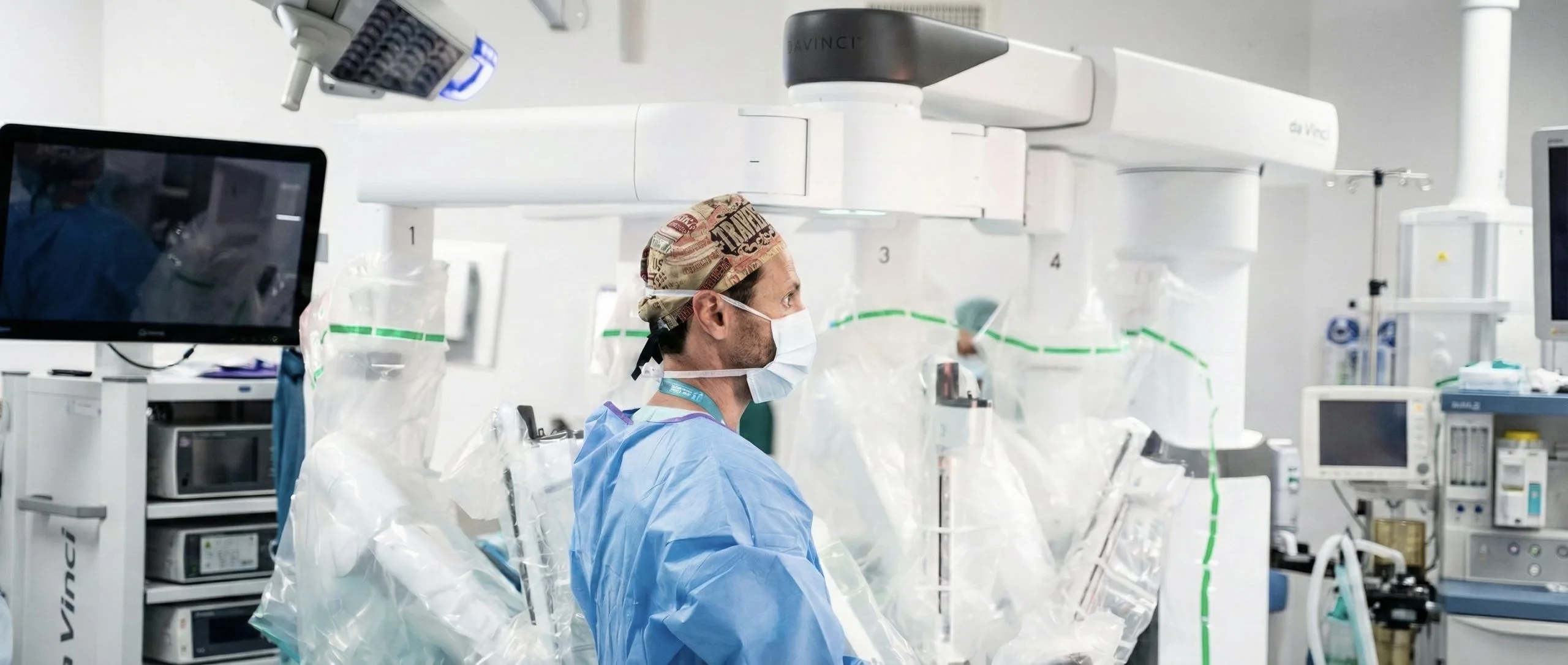
- High-Precision Technology: The use of the robotic system (such as Da Vinci®) offers magnified 3D vision and articulated instruments that allow for kidney dissection and reconstruction with superior precision compared to traditional surgery.
- Minimally Invasive Procedure: Performed through small incisions (0.5 to 1.5 cm), this technique avoids large cuts in the flank or abdomen, resulting in significantly smaller scars and better cosmetic results.
- Rapid Recovery: Patients benefit from less postoperative pain, a shorter hospital stay (usually 2 to 4 days), and a faster return to normal activities and work.
Preserving the Kidney in the Treatment of Renal Tumors
Brief Introduction:
If you have been diagnosed with a kidney tumor, it is natural that you have many questions and concerns. One of the most advanced surgical treatment options for certain renal tumors is Robotic Partial Nephrectomy. This minimally invasive procedure’s main objective is to remove the tumor completely and safely, while preserving as much healthy renal tissue and function as possible. This page was created to provide you with clear and detailed information about robotic partial nephrectomy, helping you better understand this therapeutic option and discuss your choices with your urologist.
1. What are the Kidneys and Renal Tumors? (A Brief Review)
The Kidneys: They are two vital bean-shaped organs, located in the back of the abdomen, one on each side of the spine.
Primary Functions: Filtering the blood to remove waste and excess water (producing urine), regulating blood pressure, maintaining the balance of electrolytes (such as sodium and potassium), and producing important hormones for red blood cell production and bone health.
Renal Tumors: A renal tumor is an abnormal growth of cells in the kidney. Renal tumors can be:
- Benign: Such as angiomyolipoma or oncocytoma. Generally, they do not spread to other parts of the body and may not require treatment unless they cause symptoms or are very large.
- Malignant: The most common type of kidney cancer in adults is Renal Cell Carcinoma (RCC). These tumors have the capacity to grow, invade nearby tissues, and spread to other parts of the body (metastases).
Partial nephrectomy is most frequently performed for localized malignant tumors (confined to the kidney), but it can also be considered for some symptomatic or large benign tumors.
2. What is Partial Nephrectomy (Kidney-Sparing Surgery)?
Definition: Partial nephrectomy, also known as kidney-sparing surgery or “nephron-sparing surgery,” is a surgical procedure in which only the portion of the kidney containing the tumor is removed, along with a small margin of surrounding healthy renal tissue. The rest of the kidney, which is healthy, is preserved and continues to function.
Contrast with Radical Nephrectomy: In a radical nephrectomy, the entire kidney is removed (and sometimes the adrenal gland and nearby lymph nodes).
Dual Primary Objective:
- Oncological Control: Completely remove the tumor with negative surgical margins (no cancer cells at the resection margin), with the aim of curing the cancer.
- Preservation of Renal Function: Maintain as much functional renal tissue as possible, which is crucial for long-term renal health.
Importance of Renal Preservation: Preserving renal function is fundamental to avoid or delay the development of chronic kidney disease, which can be associated with a higher risk of cardiovascular problems and lower quality of life. Partial nephrectomy is especially important for patients who:
- Already have some pre-existing chronic kidney disease.
- Have other conditions that may affect renal function in the long term (such as diabetes or high blood pressure).
- Have only one functioning kidney (solitary kidney).
- Have tumors in both kidneys (bilateral tumors).
- Have a genetic predisposition to developing multiple renal tumors.
3. What is the Robotic Approach (Robot-Assisted Partial Nephrectomy)?
Partial nephrectomy can be performed by traditional open surgery, conventional laparoscopy, or the more advanced robotic route (frequently using the Da Vinci® surgical system).
How Robotic Surgery Works:
- It is a minimally invasive technique, performed under general anesthesia.
- The surgeon makes several small incisions (usually 4 to 5, about 0.5 to 1.5 cm) in the patient’s abdomen.
- Through these incisions (“ports”), small tubes are inserted that allow the passage of a high-definition 3D video camera and miniaturized and articulated surgical instruments.
- The surgeon operates from an ergonomic console located in the operating room, where they have an enlarged and detailed three-dimensional (3D) view of the interior of the abdomen and the kidney.
- The movements of the surgeon’s hands on the console are translated in real time into precise, filtered, and intuitive movements of the instruments inside the patient’s body.
Differences and Advantages over Other Approaches for Partial Nephrectomy:
- Open Surgery: Involves a larger incision in the flank or abdomen, sometimes with the need to remove a rib. It is associated with more post-operative pain, greater blood loss, and a longer recovery.
- Conventional Laparoscopy: Uses small incisions, but the surgeon operates with long and rigid instruments, looking at a 2D monitor. Partial laparoscopic nephrectomy is technically very challenging due to the complexity of tumor removal and, mainly, the suturing of the kidney (renorrhaphy) to control bleeding and close the urinary collecting system, often under a limited time of renal ischemia (interruption of blood flow).
- Robotic Surgery: Combines the benefits of the minimally invasive approach (small incisions) with advanced technology that overcomes many of the limitations of conventional laparoscopy. 3D vision, magnification, tremor filtering, and articulated instruments (“EndoWrist®”) greatly facilitate the critical and delicate stages of partial nephrectomy, such as precise tumor dissection, identification and control of renal blood vessels, temporary global or selective vascular clamping (if necessary), excision of the tumor with adequate margins, and complex and precise reconstruction of the kidney (renorrhaphy).
4. Specific Advantages of Robotic Partial Nephrectomy
Robotic technology offers crucial advantages for performing partial nephrectomy:
Magnified 3D High-Definition Vision: Allows exceptionally clear identification of the tumor, its limits in relation to normal renal tissue, and the vascular structures and collecting system of the kidney.
Greater Precision, Dexterity, and Range of Motion: Articulated robotic instruments allow the surgeon to perform fine and precise movements, essential for excising the tumor and for delicate suturing of the kidney (renorrhaphy) in multiple layers, which is vital for controlling bleeding and preventing urinary fistulas.
Possibility of Reducing Warm Renal Ischemia Time or Performing Selective/Zero Ischemia Techniques:
- Warm Renal Ischemia: During tumor removal, it may be necessary to temporarily interrupt the main blood flow to the kidney (clamping the renal artery) to minimize bleeding. The precision and efficiency of robotic surgery can help reduce this ischemia time, which is very important for protecting renal function.
- Selective Ischemia or “Clamp-less” (No Clamping) Techniques: In some cases, depending on the location and characteristics of the tumor, robotic technology can facilitate clamping only the small vessels that supply the tumor (selective ischemia) or even removing the tumor without interrupting the main blood flow to the kidney. These techniques aim to maximize the preservation of renal function.
Better Control of Intraoperative Bleeding: And lower need for blood transfusions.
Less Post-Operative Pain: Due to smaller incisions and less surgical trauma.
Shorter Hospital Stay: Generally, patients recover more quickly.
Faster Recovery and Earlier Return to Normal Activities and Work.
Better Aesthetic Results: Scars are significantly smaller.
High Oncological Success Rates: Cancer control results with robotic partial nephrectomy are comparable to open surgery when performed by experienced surgeons.
Maximum Preservation of Renal Function: This is one of the greatest assets of the robotic approach for partial nephrectomy.
5. Who is a Candidate for Robotic Partial Nephrectomy?
The decision is always individualized, but ideal candidates generally include:
Patients with a diagnosis of localized renal tumor (i.e., confined to the kidney). The size and location of the tumor must be favorable for partial removal. Generally, it is considered for tumors classified as T1 (up to 7 cm in diameter), but in centers with great experience, it can be performed for larger (T2) or more complex tumors (e.g., more central tumors or those close to large vessels). The complexity of the tumor is often evaluated using standardized scores (such as the RENAL score or the PADUA score).
Situations where preservation of renal function is an absolute or very important priority, such as in patients with:
- Single kidney (anatomical or functional).
- Pre-existing chronic kidney disease.
- Other medical conditions that can affect long-term renal function (e.g., diabetes, uncontrolled hypertension).
- Tumors in both kidneys (bilateral).
- Family history of kidney disease or multiple renal tumors (genetic syndromes).
Not all renal tumors are amenable to partial nephrectomy (e.g., very large tumors involving a large part of the kidney, tumors with extensive invasion of major renal vessels, or if partial removal does not allow for guaranteed safe oncological margins). In these cases, a radical nephrectomy (removal of the entire kidney) may be the safest and most effective option.
6. Preparation for Surgery
Preparation for a robotic partial nephrectomy is similar to other major surgeries:
Pre-Anesthesia Consultation: Evaluation by the anesthesiologist to determine your fitness for general anesthesia.
Pre-Operative Exams: Include blood tests (CBC, coagulation, renal function, etc.), electrocardiogram (ECG), chest X-ray (if indicated), and other exams as necessary.
Medication Adjustment: You must inform your doctor about all the medication you take. Some medications, such as anticoagulants (e.g., warfarin) or antiplatelet agents (e.g., aspirin, clopidogrel), may need to be suspended a few days before surgery, under medical guidance.
Fasting: It is necessary to be fasting (not eating or drinking) for several hours before surgery (usually 6 to 8 hours), according to the anesthesiologist’s instructions.
7. The Surgical Procedure (Simplified Description for the Patient)
Anesthesia: The surgery is performed under general anesthesia.
Positioning: You will be placed in a specific position on the surgical table, usually lying on your side (lateral decubitus), to allow access to the affected kidney.
Incisions and Insufflation: The surgeon makes several small incisions (ports) in your abdomen or flank. The abdomen is then insufflated with carbon dioxide to create a workspace for the instruments.
Robot Coupling: The robotic arms, which hold the 3D camera and surgical instruments, are introduced through the ports and coupled to the robotic system.
Surgery: The surgeon, from the console, performs the surgery with meticulousness:
- Dissection and Exposure of the Kidney: The kidney is carefully dissected from surrounding tissues to expose the tumor and the renal blood vessels (artery and vein).
- Identification of the Tumor: Intraoperative ultrasound is frequently used to precisely delimit the margins of the tumor.
- Temporary Renal Ischemia (if necessary): To minimize bleeding during tumor removal, the blood flow to the kidney can be temporarily interrupted through clamping of the renal artery (total warm ischemia) or more selective arterial branches (selective ischemia). The goal is to keep this ischemia time as short as possible. In some favorable tumors, surgery can be performed without vascular clamping (“clamp-less” or zero ischemia).
- Excision of the Tumor (Tumorectomy): The tumor is carefully excised (removed) from the kidney, along with a small margin of apparently normal renal tissue around it, to ensure the complete removal of cancer cells.
- Renorrhaphy (Repair of the Kidney): After the tumor is removed, the defect in the kidney is meticulously sutured in multiple layers to control any bleeding and to close the urinary collecting system, if it was opened during the excision.
- Vascular Unclamping: If renal vessels were clamped, they are unclamped, and it is carefully checked if there is any active bleeding (hemostasis).
Finalization: The robotic instruments and arms are removed. Generally, a small abdominal dreno is left near the operated kidney.
Pathological Analysis: The tumor and the removed tissue margin are sent to a pathology laboratory for detailed microscopic analysis to confirm the type of tumor, its degree of aggressiveness, and if the surgical margins are free of cancer.
8. Post-Operative and Recovery
Hospital Stay: Most patients remain in the hospital for a period of 2 to 4 days after surgery.
Pain Control: Post-operative pain is generally mild to moderate and well controlled with analgesics.
Urinary Catheter (Sonda Vesical): Sometimes, a catheter is placed in the bladder during surgery, which is usually removed the next day or after 1-2 days.
Abdominal Dreno: If a dreno is placed, it is usually removed when the amount of drained fluid decreases significantly (usually in a few days).
Early Mobilization: You will be encouraged to get up and walk as soon as possible after surgery to help prevent complications.
Diet: Feeding is generally restarted progressively, starting with liquids and evolving to a normal diet as tolerated.
Home Recovery: Complete recovery can take a few weeks. It is normal to feel some tiredness. Physical activity should be increased gradually. Avoid intense efforts or lifting weights for 4 to 6 weeks.
Renal Function Monitoring: Renal function will be monitored with blood tests after surgery.
9. Expected Results and Potential Side Effects/Complications
Oncological Control: For localized renal tumors, robotic partial nephrectomy offers excellent cancer control rates, comparable to open surgery, provided the tumor is completely removed with negative surgical margins.
Preservation of Renal Function: This is the main benefit of partial nephrectomy. In the long term, the preservation of renal function is associated with better overall health results.
Potential Side Effects and Complications: Like any surgery, robotic partial nephrectomy has risks, although generally low and well managed in experienced centers. They include:
- Bleeding (Hemorrhage): Can occur during or after surgery. The need for blood transfusion is rare.
- Urinary Fistula (Urine Leak): Leakage of urine from the suture site on the kidney. Most resolve spontaneously with prolonged drainage or with the temporary placement of a ureteral stent (Double-J catheter).
- Infection: Of the surgical wound, urinary or intra-abdominal.
- Injury to Adjacent Organs: Such as the spleen, pancreas, intestine, or liver. They are very rare complications with robotic surgery performed by experienced teams.
- Acute Renal Insufficiency or Worsening of Chronic Kidney Disease: The risk is minimized by the preservation of renal tissue and by the attempt to reduce ischemia times.
- Need to Convert to Radical Nephrectomy (Total Kidney Removal): In rare situations, if during surgery it is verified that safe partial removal of the tumor is not technically possible.
10. Medical Follow-up
After surgery, you will have a plan for regular follow-up with your urologist, which is crucial for:
Monitoring your recovery.
Evaluating renal function (with blood and urine tests).
Performing periodic imaging tests (usually Computed Tomography – CT or Magnetic Resonance Imaging – MRI) to monitor the kidneys and detect any local recurrence or metastases.
11. My Experience with Robotic Partial Nephrectomy
Robotic partial nephrectomy is, in my opinion and clinical practice, the procedure of choice and the standard of excellence for the treatment of most renal tumors that are amenable to a kidney-conserving approach. This minimally invasive technique allows us to uniquely combine the fundamental objectives of oncological surgery – the complete and safe removal of the tumor – with the maximum preservation of healthy renal tissue, a factor critical for the long-term renal and cardiovascular health of my patients. The high-definition magnified 3D vision and the precision of the robotic instruments are invaluable advantages, especially when dealing with tumors in challenging locations or when seeking to minimize renal ischemia time. My primary goal in each robotic partial nephrectomy is to offer effective oncological treatment, with a quick recovery, less pain, and the best possible functional preservation, always adapting the technique to the particularities of each case.
12. Final Message
Robotic partial nephrectomy represents one of the most significant advances in the surgical treatment of renal tumors, offering a highly effective and safe option that prioritizes not only the cure of the cancer but also the preservation of renal function and the quality of life of the patient. If you have been diagnosed with a renal tumor and have been informed that partial nephrectomy is a therapeutic option, the robotic approach can be the best choice for you. I invite you to schedule a consultation so that we can discuss in detail your specific case and help you take an informed decision about your treatment.