


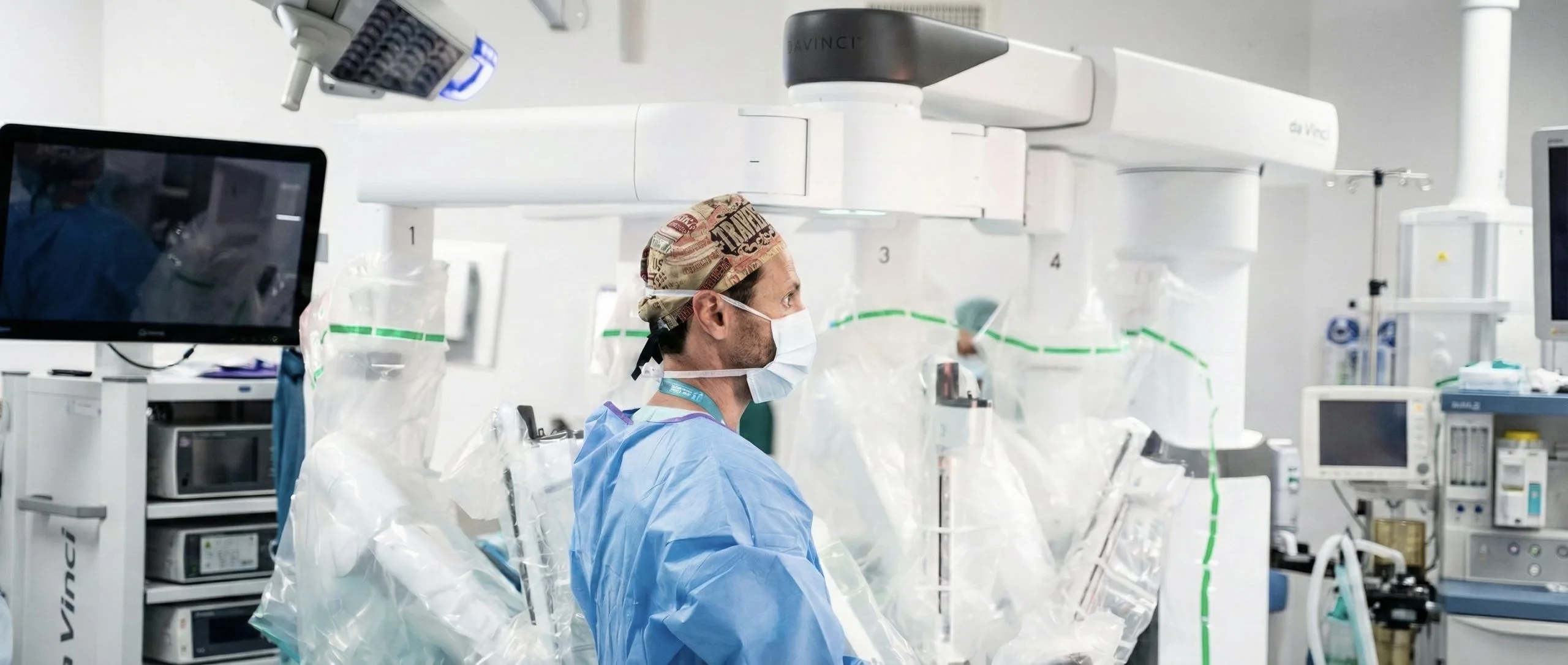
If you have been diagnosed with kidney cancer and your urologist has recommended the complete removal of the affected kidney (radical nephrectomy), the robot-assisted surgical approach (RARN) is one of the most advanced and least invasive options available today.
The primary goal of this surgery is to remove the cancerous tumor in its entirety with the intent to cure. This information was created to provide you with clear and detailed details about robotic radical nephrectomy, helping you better understand this treatment and discuss your options with your medical team.
1. What are the Kidneys and Kidney Cancer?
The Kidneys: Two vital organs responsible for filtering the blood, removing waste and excess fluids (producing urine), regulating blood pressure, maintaining electrolyte balance, and producing important hormones.
Kidney Cancer (Renal Cell Carcinoma – RCC): A malignant tumor that originates in the kidney cells.
Robotic radical nephrectomy is typically considered for larger renal tumors or for those which, due to their location or characteristics, cannot be safely removed through a partial nephrectomy (removing only the tumor) while maintaining oncological safety.
2. What is Radical Nephrectomy (RN)?
Definition: A surgical procedure that consists of the complete removal of the kidney containing the tumor.
Extent: Often, the surgery also includes the removal of the adrenal gland (located on the upper pole of the kidney) and the fatty tissue surrounding the kidney (perirenal fat).
Lymphadenectomy: In some cases, depending on the extent and aggressiveness of the tumor, regional lymph nodes may also be removed.
Main Objective: The primary goal is the complete removal of the renal cancer to cure the disease when it is localized or locally advanced but still resectable.
When is Radical Nephrectomy indicated instead of Partial?
While partial nephrectomy (preserving the kidney) is preferred whenever possible, radical nephrectomy is generally indicated in the following situations:
- Large Renal Tumors: When the tumor is very voluminous and occupies a large part of the kidney.
- Complex Tumor Location: Tumors located very centrally, involving major renal blood vessels (artery and vein) or the urinary collecting system extensively, making partial removal technically difficult or oncologically unsafe.
- Diminished Function: If the affected kidney already has very low function due to other reasons.
- Locally Advanced Disease: In cases where tumors invade neighboring structures or present a tumor thrombus extending into the renal vein or the vena cava (the main vein of the abdomen).
It is fundamental that the contralateral kidney (the kidney on the other side) is healthy and has adequate function to maintain blood filtration after surgery.
3. What is the Robotic Approach (RARN)?
Radical nephrectomy can be performed via traditional open surgery, conventional laparoscopy, or the more advanced robotic route (RARN), frequently using the Da Vinci® Surgical System.
How It Works:
- Performed under general anesthesia.
- The surgeon makes several small incisions (usually 4 to 5) in the abdomen or flank.
- Through these “ports,” a high-definition 3D camera and miniaturized, articulated instruments are inserted.
- The surgeon operates from an ergonomic console, where they have a magnified and detailed 3D view of the surgical field.
- The system translates the surgeon’s hand movements in real-time into precise, filtered movements of the instruments inside the patient’s body.
4. Advantages of Robotic Radical Nephrectomy (RARN)
Magnified 3D HD Vision: Exceptional clarity of the kidney, renal vessels, adrenal gland, and surrounding structures.
Greater Precision and Dexterity: Articulated instruments (EndoWrist®) allow for fine and complex movements, facilitating safe dissection—especially in identifying and controlling renal vessels before ligation.
Better Vascular Control: Robotic precision facilitates the safe ligation (closure) of the renal artery and vein, a crucial step in the surgery.
Clinical Benefits: Less blood loss, reduced need for transfusions, less post-operative pain, shorter hospital stays, and faster recovery.
Aesthetics: Scars are significantly smaller and more discreet.
5. Who is a Candidate for RARN?
Ideal candidates generally include:
Patients for whom radical nephrectomy is the most indicated treatment.
Patients with a healthy and functional contralateral kidney.
Patients in adequate physical condition to tolerate general anesthesia and the surgical position (usually lying on the side).
Certain situations, such as tumors with very extensive invasion of neighboring organs or complex tumor thrombi in the vena cava, may still require an open approach, though robotic surgery is progressively being used for complex cases in highly experienced centers.
6. Preparation for Surgery
Pre-Anesthesia Consultation: Evaluation by the anesthesiologist.
Exams: Blood tests, EKG, and imaging.
Medication Adjustment: Suspending anticoagulants or antiplatelet agents as directed by your doctor.
Fasting: As instructed by the surgical team.
7. The Surgical Procedure (Simplified)
Anesthesia and Positioning: Performed under general anesthesia with the patient placed on their side.
Access: Small incisions are made, and the abdomen is inflated with CO2 to create a workspace.
Dissection: The kidney, perirenal fat, and (often) the adrenal gland are freed from surrounding tissues.
Vascular Control: The renal artery and vein are isolated, ligated (with clips or staples), and divided.
Ureter Dissection: The ureter is identified, ligated, and divided.
Specimen Removal: The kidney and tumor are placed in a special extraction bag (endobag) and removed through one of the incisions (which may be slightly enlarged).
Finalization: A small drain may be left near the surgical area, and the incisions are closed.
8. Post-Operative and Recovery
Hospital Stay: Usually lasts 2 to 4 days.
Catheter and Drains: A bladder catheter may be used for 1–2 days (though not always necessary). Drains are typically removed before discharge.
Early Mobilization: Walking as soon as possible is encouraged to prevent complications like thrombosis.
Recovery at Home: It is normal to feel fatigue for a few weeks. Activity should be increased gradually, avoiding intense efforts for several weeks.
Renal Function: Long-term function will depend on the remaining kidney, which will be monitored regularly.
9. Expected Results and Potential Side Effects
Oncological Control: The main goal is the cure. Success rates depend on the stage and grade of the tumor at the time of surgery.
Living with One Kidney: Most patients tolerate living with a single kidney very well, as the remaining kidney compensates for the function of the one removed.
Potential Risks: Like any major surgery, risks include bleeding, infection, deep vein thrombosis, or injury to adjacent organs (bowel, spleen, pancreas). There is a long-term risk of developing or worsening chronic kidney disease, especially if pre-existing factors (diabetes, hypertension) are present.
10. Medical Follow-up
Follow-up is lifelong and includes:
Monitoring Recovery: Evaluating healing and general well-being.
Renal Function: Regular blood (creatinine) and urine tests, and blood pressure control.
Cancer Surveillance: Periodic imaging (CT or MRI of the chest, abdomen, and pelvis) to detect any recurrence or metastasis.
11. My Experience with Robotic Radical Nephrectomy
“Robotic Radical Nephrectomy (RARN) is my preferred approach and the standard of treatment I offer to most patients where the complete removal of the organ is indicated. This minimally invasive technique allows me to perform this oncological procedure with a level of precision, visualization, and control that I consider superior. This contributes to minimizing blood loss, reducing surgical trauma, and optimizing safety. My primary goal is to achieve the best possible cancer control results while providing a faster recovery and less pain compared to traditional open surgery.”
12. Final Message
RARN is a modern, safe, and effective treatment for kidney cancer. If you have been recommended a radical nephrectomy, the robotic approach is often the best surgical choice available today. I invite you to schedule a consultation so we can discuss your specific case and help you make an informed and confident decision.