


HIGHLIGHTS:
Caring for your health, prioritizing your quality of life.
- Complete and Safe Tumor Removal: The tumor is removed with high precision and safety margins, strictly following oncological criteria to ensure maximum safety and minimize the risk of recurrence.
- Full Preservation of Urinary Continence: We carefully preserve the urinary sphincter and bladder support structures, using precise reconstruction techniques that facilitate a faster recovery of urinary control. Continence rates are >95%.
- Preservation of Sexual Function: Surgery is performed with the utmost care to preserve the nerves responsible for erection, whenever clinically safe, significantly reducing the risk of sexual dysfunction after treatment.
- Superior Results with Minimally Invasive Robotic Surgery: Advanced robotic techniques result in less pain, a faster recovery, and a quicker return to your daily routine with minimal impact on your life.
- Integrated Multidisciplinary Care: A specialized team accompanies you throughout the entire journey—from preoperative preparation to post-surgical rehabilitation—ensuring you are supported at every stage of your treatment.
If you have been diagnosed with prostate cancer and are considering your treatment options, you have likely heard of Robotic Radical Prostatectomy.
This is an advanced minimally invasive surgery designed to remove the prostate and the cancer with the goal of curing the disease, while seeking to minimize side effects and accelerate recovery.
Making a decision about prostate cancer treatment is a significant step. This information was created to provide you with clear and comprehensive details about robotic radical prostatectomy so that you can discuss your options with your urologist in an informed manner
1. What is Prostate Cancer?
The Prostate: A small gland of the male reproductive system, approximately the size of a walnut, located below the bladder and in front of the rectum.
The Urethra: The canal that carries urine from the bladder out of the body passes through the center of the prostate.
Function: Its main function is to produce part of the fluid that makes up semen.
Prostate Cancer: Occurs when cells in the prostate begin to grow in an uncontrolled and invasive manner.
Robotic radical prostatectomy is a primary treatment for localized prostate cancer, meaning when the disease is confined to the prostate or its immediate vicinity, without evidence of spread to distant organs.
2. What is Radical Prostatectomy?
Definition: Radical prostatectomy is a surgical procedure involving the complete removal of the prostate gland and the seminal vesicles (small glands attached to the prostate that also contribute to semen).
Lymphadenectomy: In many cases, especially if the cancer has higher-risk characteristics, nearby pelvic lymph nodes (which can be the first site of cancer spread) are also removed during the same surgery.
Main Objective: The primary goal is to remove all cancerous tissue with the intent of curing the prostate cancer.
Indications: It is a treatment of choice for men with clinically localized prostate cancer. In some selected cases of locally advanced disease, it may be part of a multimodal treatment strategy (combined with radiotherapy or hormone therapy).
The decision to perform a radical prostatectomy depends on several factors, including the stage and grade (aggressiveness) of the tumor, PSA levels, the patient’s age, general health status, and personal preferences.
3. What is the Robotic Approach (Robot-Assisted Radical Prostatectomy)?
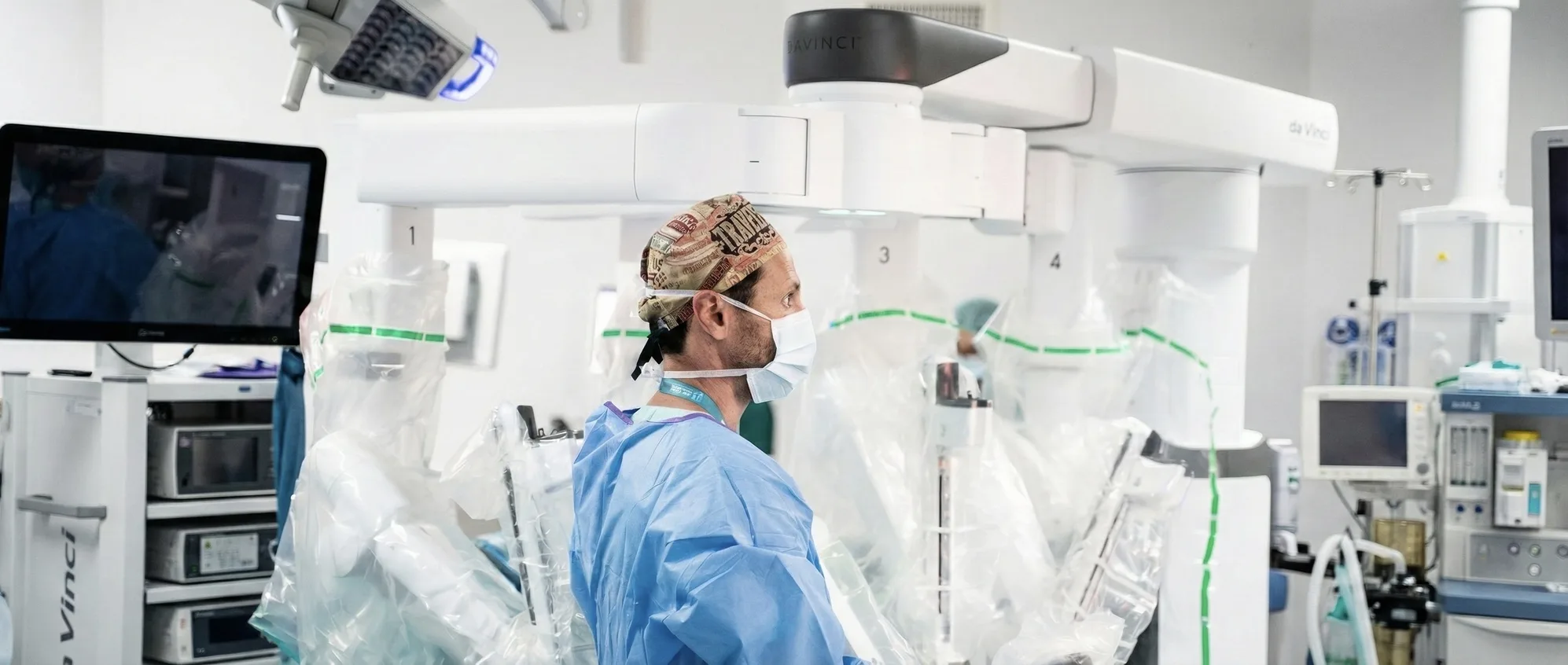
Radical prostatectomy can be performed in several ways (open, conventional laparoscopic). The robotic approach (frequently using the Da Vinci® Surgical System) is the most advanced form of minimally invasive surgery.
How It Works:
- The surgery is performed under general anesthesia.
- Several small incisions (usually 5 to 6, about 0.5 to 1 cm each) are made in the patient’s abdomen.
- Through these incisions (“ports”), small tubes are inserted to allow the passage of a high-definition video camera and miniaturized surgical instruments.
- The surgeon does not operate directly on the patient but from an ergonomic console located in the same operating room.
- At this console, the surgeon has a magnified 3D high-definition view of the interior of the patient’s pelvis.
- The surgeon controls robotic arms that hold the instruments. Their hand movements are translated in real-time into precise, delicate movements inside the body.
- The system filters out any natural hand tremors and allows for a range of motion exceeding that of the human hand.
Differences from Open and Conventional Laparoscopic Surgery:
- Open Surgery: Involves a single larger abdominal incision (usually from below the navel to the pubic bone).
- Conventional Laparoscopy: Uses small incisions and long instruments, but the surgeon operates looking at a 2D monitor, and the instruments do not have the same articulation as robotic ones.
- Robotic Surgery: Combines the advantages of laparoscopy (small incisions, less trauma) with cutting-edge technology providing superior 3D vision, greater precision, better ergonomics, and highly articulated instruments for complex maneuvers.
4. Advantages of Robotic Radical Prostatectomy
The robotic technology offers significant advantages:
Magnified 3D HD Vision: Provides an exceptionally clear view of pelvic anatomy, including delicate neurovascular bundles (for erectile function) and the urinary sphincter (for continence).
Greater Precision and Dexterity: Robotic instruments (EndoWrist®) have joints that mimic and exceed the human wrist, allowing fine movements in confined spaces.
Nerve Preservation: Superior visualization allows for a more careful dissection and a higher probability of preserving nerves responsible for erection (nerve-sparing), when oncologically safe.
Sphincter Preservation: Better preservation of the urinary sphincter structure and urethral length, crucial for faster recovery of continence.
Precise Reconstruction: The connection (anastomosis) between the bladder and the urethra can be performed with great precision, essential for healing and continence.
Clinical Benefits: Less blood loss (lower transfusion risk), less post-operative pain, shorter hospital stay (1 to 3 days), faster recovery, and better aesthetic results (smaller scars).
5. Who is a Candidate for Robotic Radical Prostatectomy?
While the final decision is always individualized, ideal candidates generally include:
Men with a diagnosis of clinically localized prostate cancer.
Men with a reasonable life expectancy (usually over 10-15 years) to benefit from the long-term cure.
Men in adequate physical condition to tolerate general anesthesia and the specific surgical position (Trendelenburg, with the head lower than the feet).
Certain situations, such as extensive previous abdominal surgeries, extreme morbid obesity, or severe cardiopulmonary conditions, may increase surgical risk and must be evaluated case-by-case.
6. Preparation for Surgery
Pre-Anesthesia Consultation: Evaluation by the anesthesiologist.
Pre-Operative Exams: Blood tests, electrocardiogram (ECG), and other necessary tests.
Medication Adjustment: Anticoagulants or antiplatelet agents (e.g., aspirin, clopidogrel) may need to be suspended days before surgery under medical guidance.
Fasting: Necessary for several hours before surgery.
7. The Surgical Procedure (Simplified Description)
Anesthesia: Performed under general anesthesia.
Incisions and Insufflation: Small incisions are made, and the abdomen is insufflated with CO2 to create a workspace.
Robotic Docking: Robotic arms are introduced through the ports and coupled to the system.
Surgery: The surgeon removes the prostate and seminal vesicles, and if indicated, the pelvic lymph nodes.
Reconstruction: The bladder is sutured to the urethra (urethrovesical anastomosis) over a urinary catheter.
Pathological Analysis: The removed tissue is sent to a lab to confirm cancer extension and surgical margins.
8. Post-Operative and Recovery
Hospital Stay: Usually 1 to 3 days.
Urinary Catheter: Stays in place for 7 to 14 days to allow the suture to heal.
Early Mobilization: Encouraged to walk as soon as possible to prevent complications like thrombosis.
Diet: Restarted progressively, beginning with liquids.
Recovery at Home: Fatigue is normal for the first few weeks. Avoid heavy lifting or intense efforts for 4 to 6 weeks.
Kegel Exercises: Pelvic floor exercises are highly recommended to help recover urinary continence.
9. Expected Results and Potential Side Effects
Oncological Control: After successful surgery, PSA levels should drop to undetectable values (usually <0.1 ng/mL) within 4 to 6 weeks.
Urinary Incontinence: Involuntary leaks are common immediately after catheter removal. Most men regain good control within 6 to 12 months.
Erectile Dysfunction: The ability to have an erection may be affected. Recovery can be gradual, sometimes taking 1 to 2 years, and can be aided by penile rehabilitation programs.
Other Risks: Infection, bleeding (rare with robotics), injury to adjacent organs (very rare), or hernia.
10. Medical Follow-up
Follow-up includes:
Periodic consultations.
Regular PSA tests (every 3-6 months in the first years, then annually).
Evaluation and management of urinary and sexual function.
11. My Experience with Robotic Radical Prostatectomy
“Robotic radical prostatectomy is the surgical technique I preferentially use and consider the gold standard for treating localized prostate cancer in my clinical practice. The vast experience I have accumulated, combined with a deep knowledge of pelvic anatomy, allows me to offer patients the benefits of a highly precise surgery meticulously planned to eradicate cancer. Equally important is my commitment to optimizing functional results, namely urinary continence and erectile function. The combination of cutting-edge technology, surgical experience, and individualized, compassionate care are key to achieving the best possible results.”
12. Final Message
Robotic radical prostatectomy is a highly effective and safe treatment. If you have been diagnosed with prostate cancer, I invite you to schedule a consultation so we can discuss your specific case and help you make the most informed decision for your health and well-being.